
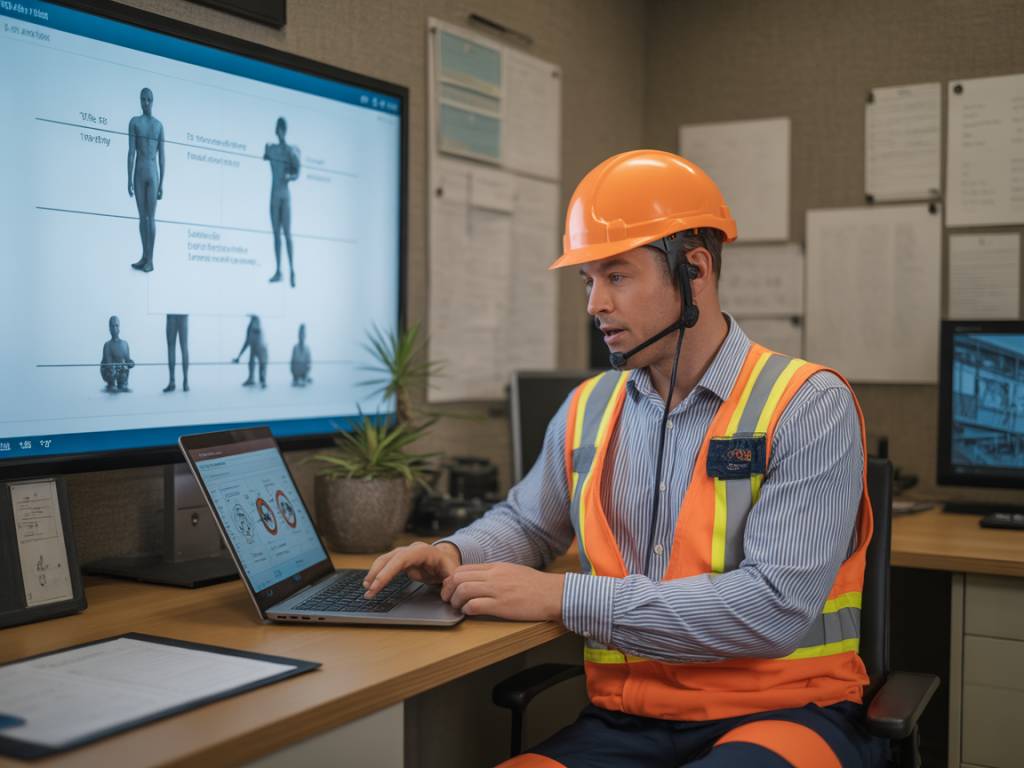
If you run health and safety training today the same way you did ten years ago, you’re already behind.
Workforces are more spread out, staff turnover is faster, and people expect to learn the way they do everything else: on their phone, on demand, and only what they actually need. That’s exactly where blended learning comes in.
Blended learning is simple: you mix online and face-to-face training instead of betting everything on just one method. Done right, it’s faster, cheaper, and more effective. Done wrong, it’s just more admin and more bored employees.
In this article we’ll look at:
- Why blended learning is growing so fast in health and safety
- What it really looks like in different workplaces
- How to design a blended system that actually changes behaviour, not just ticks boxes
- Practical templates you can copy tomorrow
Why blended learning exploded in health and safety
Let’s be honest: traditional health and safety training has a reputation problem. A lot of staff hear “safety induction” and think “half a day of PowerPoint and free biscuits”.
Three things have pushed organisations towards blended learning:
- Regulation isn’t going away. If anything, it’s getting tighter. You still need traceable, auditable training records.
- Workforces are more flexible. Contractors, remote staff, shift patterns. Getting everyone in a room at the same time is a nightmare.
- Tech is cheap and available. Ten years ago, an LMS was a big investment. Now, even small companies can run decent online modules.
So the question is not “Do we go blended?” It’s “How do we build a blended system that works in our real-world constraints?”
What “good” blended learning looks like
Think like a coach planning a training week. You don’t put max strength, long intervals, and heavy conditioning all on the same day. You choose the right tool for the right objective.
Blended learning is the same. Use each mode for what it does best:
- Online modules: Theory, rules, procedures, basic knowledge checks.
- Face-to-face workshops: Practice, discussion, problem solving, culture building.
- On-the-job coaching: Real behaviour change, corrections, habit building.
Here’s a simple example for manual handling training:
- Step 1 – Online (20–30 minutes): Basic anatomy, risk factors, legal duties, short quiz.
- Step 2 – Face-to-face (45–60 minutes): Practical lifting technique, team lifting, using equipment, scenarios.
- Step 3 – On-the-job (5–10 minutes per worker): Supervisor checks real lifts over the next week, gives 1–2 corrections each time.
Result: less classroom time, better retention, and behaviour that actually changes on the shop floor.
Matching the blend to your workplace
Different environments need different blends. Trying to copy-paste the same format everywhere is like giving the same training plan to a sprinter and a marathon runner.
Blended learning in high-risk, hands-on environments
Think: construction, manufacturing, warehouses, utilities.
Here, “just online” is a non-starter. People need to move, handle tools, use PPE properly, and make safe decisions in messy, noisy conditions.
A workable blend might look like this:
- Online pre-work (15–30 minutes):
- Hazard awareness videos from your own site, not stock images
- Short modules on permits, lockout/tagout basics, site rules
- Quick quizzes (5–10 questions) to check understanding
- Face-to-face practical (60–90 minutes):
- Walk the site and identify hazards in real time
- Practice using equipment and PPE correctly
- Run through 3–4 realistic emergency scenarios
- On-the-job reinforcement (ongoing):
- Supervisors run weekly 5-minute “safety huddles” with one micro-topic (e.g. “Today: hand injuries”)
- Monthly short refreshers online (5–10 minutes) focused on recent incidents or near misses
Metrics to watch:
- Completion rate for pre-work (aim: >90% before face-to-face)
- Practical assessment pass rate on first attempt (aim: >80%)
- Number of near misses reported vs serious incidents (you usually want near misses up, serious incidents down)
Blended learning in offices and low-risk environments
Think: offices, call centres, remote workers.
Here, the biggest risk is often boredom and box ticking. People sit through long sessions on fire safety and DSE that they forget within a week.
A better blend:
- Core safety topics online (15–20 minutes each):
- Fire safety basics
- DSE and ergonomics
- General workplace hazards
- Mental health and stress awareness
- Short, targeted workshops (30–45 minutes):
- Run once per quarter, not once per year
- Focus on real issues: slips in the car park, burnout in a busy quarter, lone working, etc.
- Case study: match your own incidents, not generic stories
- Micro-learning nudges:
- 2–3 minute videos or tips sent every month
- Quick polls (“How many breaks did you take from your screen yesterday?”)
Key is to break the “one giant annual session” into smaller, more regular hits. Like training: frequency often beats volume.
Blended learning for remote and hybrid teams
This is where many organisations struggle. Remote staff often get left out or treated as an afterthought. That’s risky and inefficient.
You can still blend, but the “face-to-face” might be virtual:
- Self-paced e-learning (10–20 minutes): Core theory, quizzes, downloadable checklists.
- Live virtual sessions (30–60 minutes): Run on Teams/Zoom, with cameras on, discussion-based, using breakout rooms for scenarios.
- 1:1 manager follow-up (5–10 minutes): Quick check-in: “What did you actually change after the training?”
To keep it effective:
- Cap virtual groups to 10–12 people so everyone speaks at least once.
- Use real examples from their work set-up (home office photos, travel situations, lone working cases).
- Record sessions but don’t rely only on recordings; live interaction is where behaviour starts to shift.
A simple framework to design your blend
Here’s a basic process you can reuse for any health and safety topic:
- Step 1 – Define the behaviour, not the course.
- Bad: “We need a 2-hour COSHH course.”
- Better: “We need staff to wear the right PPE every time they handle substance X and store it correctly.”
- Step 2 – Split content into three buckets:
- Know: facts, rules, procedures → mostly online.
- Do: skills, actions, use of equipment → face-to-face / practical.
- Keep doing: habits, culture → on-the-job, micro-learning.
- Step 3 – Set hard limits.
- Max online module length (e.g. 20 minutes).
- Max workshop size (e.g. 12–15 people).
- Minimum follow-up checks (e.g. 2 observations per worker in the first month).
- Step 4 – Decide how you’ll measure success.
- Not just “attendance”.
- Look at incident data, near misses, audit findings, PPE compliance rates, etc.
If you can’t describe the target behaviour and how you’ll measure it, you’re not ready to pick the blend.
Common mistakes with blended health and safety training
I’ve seen the same errors again and again, in gyms, factories, offices and on building sites. Here are the big ones.
- Copying generic e-learning and hoping it fits.
- Problem: Stock modules show hazards that don’t exist in your workplace, and miss the ones that do.
- Fix: Keep the generic parts (law, basic concepts), but add 10–15 minutes of site-specific content: photos, videos, examples, short scenarios.
- Overloading the online part.
- Problem: 60–90 minute modules everyone clicks through while half-listening.
- Fix: Break into shorter chunks (10–20 minutes max) with a clear outcome for each. If you need 60 minutes of content, split it into 3 parts over time.
- Treating face-to-face as a lecture.
- Problem: Trainer spends 90% of the time talking, participants sit and listen.
- Fix: Make at least 50% of face-to-face time active: practice, discussion, scenarios, role play, walk-arounds.
- No link between training and supervision.
- Problem: Staff do the course, then their supervisor ignores everything and tells them to “just get it done”.
- Fix: Train supervisors in parallel. Give them checklists, scripts for toolbox talks, and simple observation tools.
- No refresh, no progression.
- Problem: Same induction every year, copy-paste.
- Fix: Use your own incident data to update content at least once a year. Short refreshers beat full repetition.
Making it work across diverse roles and abilities
In sport, you don’t coach a beginner the same way you coach a pro. Same in the workplace: age, language, experience and confidence levels all matter.
To make blended learning work for everyone:
- Vary formats.
- Use text, audio, images and video.
- Keep language simple; avoid jargon where you can.
- Add voice-over or captions to help different learning preferences and abilities.
- Plan for low digital skills.
- Offer short “how to use the platform” guides.
- Allow time in the shift where staff can complete modules with help nearby.
- Respect experience, but don’t skip the basics.
- Use diagnostic quizzes at the start; if someone scores very high, give them a fast-track option.
- Still require practical demos for high-risk tasks, even for experienced workers.
- Use real stories from your own site.
- Ask staff about near misses and small incidents.
- Turn these into 2–3 minute case studies in your training.
When people see their own world in the training, engagement goes up fast.
Practical templates you can copy
Here are three simple blended blueprints you can adapt immediately.
Template 1: New starter health and safety induction
- Before day 1 (online, 30–40 minutes):
- Company safety culture and expectations (5–10 minutes)
- Basic legal duties (5 minutes)
- General workplace hazards (10–15 minutes)
- Short quiz (10 questions, 80% pass mark)
- Day 1 (face-to-face, 45–60 minutes):
- Site walk-around with hazard spotting
- Emergency procedures drill (fire, first aid)
- Key do’s and don’ts for their specific role
- First week (on-the-job, 10–15 minutes total):
- Supervisor checks PPE, procedures and risk awareness during real tasks
- One short feedback conversation: “What’s still unclear? What feels unsafe?”
Template 2: Annual refresher for a mixed workforce
- Month 1 (online, 15–20 minutes):
- Short recap of key rules
- Update on last year’s incidents and lessons learned
- Month 2 (face-to-face, 30–45 minutes):
- Small group workshop focusing on 2–3 real scenarios from your site
- Staff propose practical changes; manager notes and feeds back later
- Month 3 (micro-learning, 5 minutes):
- Final online quiz or scenario game based on any new controls or changes introduced
Template 3: Introducing a new high-risk procedure
- Week 0 (online briefing, 10–15 minutes):
- Why the new procedure is needed (incident, near miss, new equipment)
- What’s changing and what stays the same
- Week 1 (face-to-face, 60–90 minutes):
- Detailed walk-through of the new procedure
- Hands-on practice with real equipment
- Assessment: each worker demonstrates the procedure
- Weeks 2–4 (on-the-job checks):
- Supervisor observes 2–3 real tasks per worker using a simple checklist
- Quick corrections plus capture of any barriers or issues
- Week 5 (online follow-up, 5–10 minutes):
- Short survey and quiz: “What’s working? What’s still confusing?”
Turning blended training into real-world results
No manager gets promoted for “most SCORM modules deployed”. You’re judged on accidents, downtime, staff retention, insurance claims, audits.
To make your blended system drive real results:
- Connect training to KPIs.
- Pick 2–3 safety indicators you want to influence for each training programme.
- Track them 3–6 months before and after implementation.
- Make follow-up non-negotiable.
- Set clear expectations for supervisors: number of observations per month, toolbox talks to run, etc.
- Keep it light but consistent: small actions, often.
- Review and adjust like a training plan.
- Every 6–12 months, review what’s working.
- Cut what isn’t used, double down on what changes behaviour.
Blended learning isn’t a magic trick. It’s just smart periodisation applied to training minds instead of muscles: right content, right format, right time, for the right people.
If you treat your health and safety training with the same discipline you’d use to prep an athlete for a big season—clear goals, measured progress, regular adjustments—you’ll get the same outcome: fewer injuries, better performance, and a team that actually knows what to do when it matters.